FOR FORWARD-DEPLOYED ENGINEERING
The assessment layer that points forward-deployed engineering at the value.
As forward-deployed engineering becomes a standard delivery model across the major AI labs and consultancies, one thing stays constant: the model itself is the smallest part of the work. Most of the value sits in people and process, which is also where the blind spots tend to hide. Vane Loop runs the maturity, feasibility, and value-mapping step that points a forward-deployed engagement at the value, before a single engineer is committed.
WHY THE ROLE EXISTS
With FDE becoming the standard, the "70%" is the part that remains unresolved.
Studies of AI initiatives tend to converge on a similar split of where the effort really goes. Only a small share of the work is the algorithm itself; a larger share is the technology and data around it; and the majority is people and process. As the models commoditise, the value keeps moving toward that operating-model layer — the part a forward-deployed engineer cannot solve by writing code alone.
You can deploy the engineers — you still have to aim them.
A forward-deployed team can wire up the technology and ship the model, but on day one it cannot tell you which initiative is genuinely feasible, which is still aspirational, where the data foundations are missing, or what each bet is actually worth to the P&L.
That is the part that decides whether the engagement returns anything, and it is exactly what Vane Loop turns into an evidence base — so the team commits against numbers rather than against a pitch.
THE BLIND SPOT
Without an evidence base, the engagement commits on a pitch.
Data and AI blind spots are spread across enterprise IT and every business area that touches data, and they usually stay invisible until a forward-deployed team is already mid-build.
What tends to go wrong without it
- Two teams fund the same capability on two platforms, and nobody sees the overlap
- Aspirational use cases get staffed before the data foundation exists to support them
- Business cases carry unpriced assumptions and hidden FTE and run cost
- There is no maturity baseline, so "we're not ready" stays an opinion rather than a number
- The engineer ships, the value never quite lands, and nobody can say why
What Vane Loop puts in its place
- Duplicate platforms and tools surfaced across the whole portfolio
- The feasible separated from the aspirational against a scored maturity baseline
- A finance-grade P&L per use case, covering CapEx, OpEx, COGS, SG&A, and FTE
- Every initiative mapped to the effort it needs, the line that owns it, and a risk-adjusted return
- One consistent method, applied the same way across every engagement
WHERE VANE LOOP FITS
A maturity and feasibility step that points the work.
Before a team is committed, the people committing it need to know where the value actually sits. A structured assessment runs first, and the forward-deployed engineers then build against the gaps that matter most.
Capture
Bring in the business-case decks, spreadsheets, and architecture docs. The Vane Loop Agent extracts the savings, costs, and parameters automatically.
Assess
Score data and AI maturity and feasibility across governance, architecture, and people, with a structured questionnaire behind every number.
Map value
Attach each initiative to its unit economics, a finance-grade P&L, and a risk-adjusted return, and separate what can ship from what cannot yet.
Point the team
Commit forward-deployed engineers against evidence, with the owning line, the effort, and the return all on the table first.
A WORKED EXAMPLE
From a dropped deck to a board-ready view, across two altitudes.
The walkthrough below is illustrative, and every figure in the screenshots is just an example of what the platform produces. A forward-deployed team is about to mobilise on a portfolio of AI use cases, so the assessment runs first — tactical at the level of a single use case, and strategic at the level of the whole group portfolio.
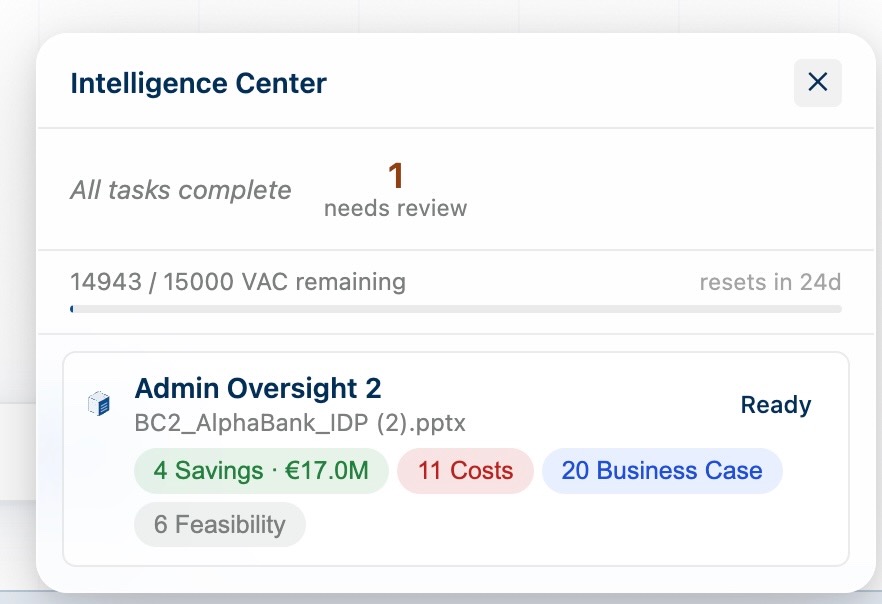
A business-case deck goes in, and structured signal comes back out.
The team drops an existing deck or spreadsheet into the Intelligence Center, and Vane Loop reads it back as structured signal: the claimed savings, the costs, the business-case parameters, and the feasibility drivers. Each one becomes an object you can price and govern, rather than a bullet on a slide that nobody revisits.
The specific savings and counts you see in the screenshot are simply what this one example deck happened to contain.
ALTITUDE 1 · TACTICAL — A SINGLE USE CASE
Is this use case feasible, and what is it actually worth?
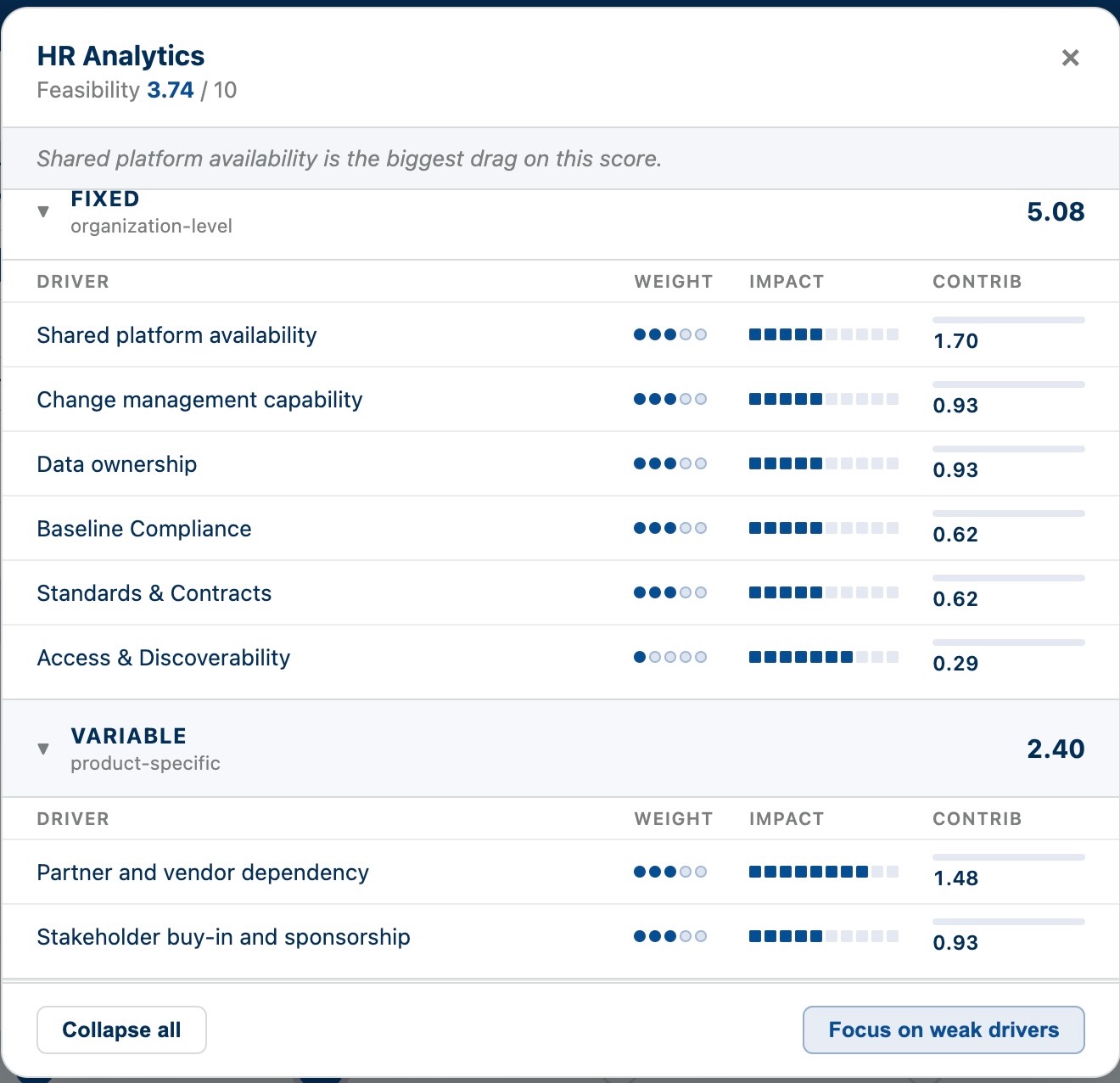
Feasibility is scored, not assumed
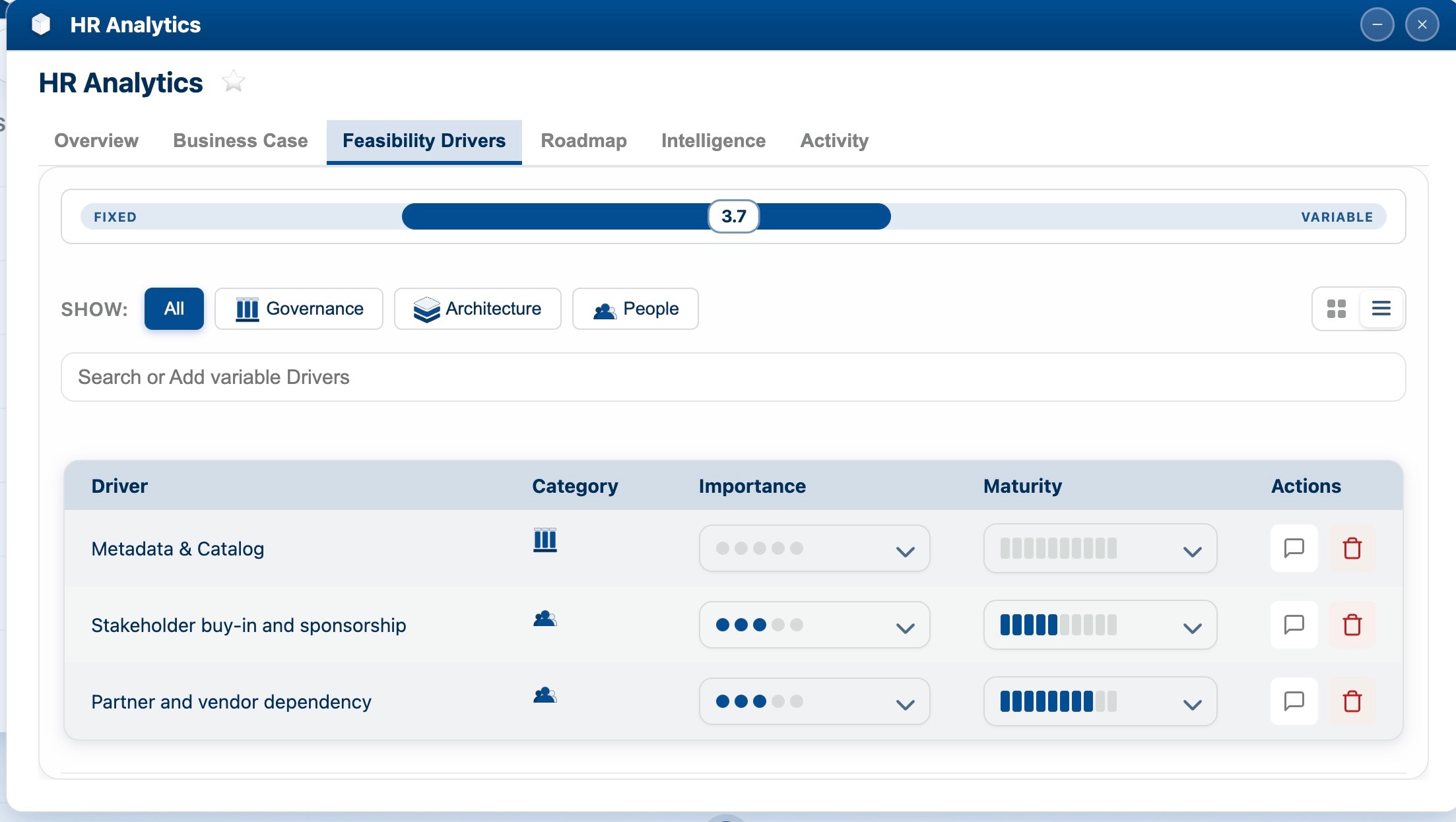
Rather than hand back a single number, the model surfaces the binding constraint — the one driver dragging the score down. In the example on the right, shared platform availability is a fixed, organisation-level gap that no amount of use-case-level effort can close, and that is exactly the kind of finding that should reorder what the forward-deployed team builds first.
- Fixed, organisation-level drivers separated from variable, product-specific ones
- Weight and impact combined into a contribution, so the weakest lever is obvious
- Data maturity placed on a six-rung ladder rather than left to a gut feel
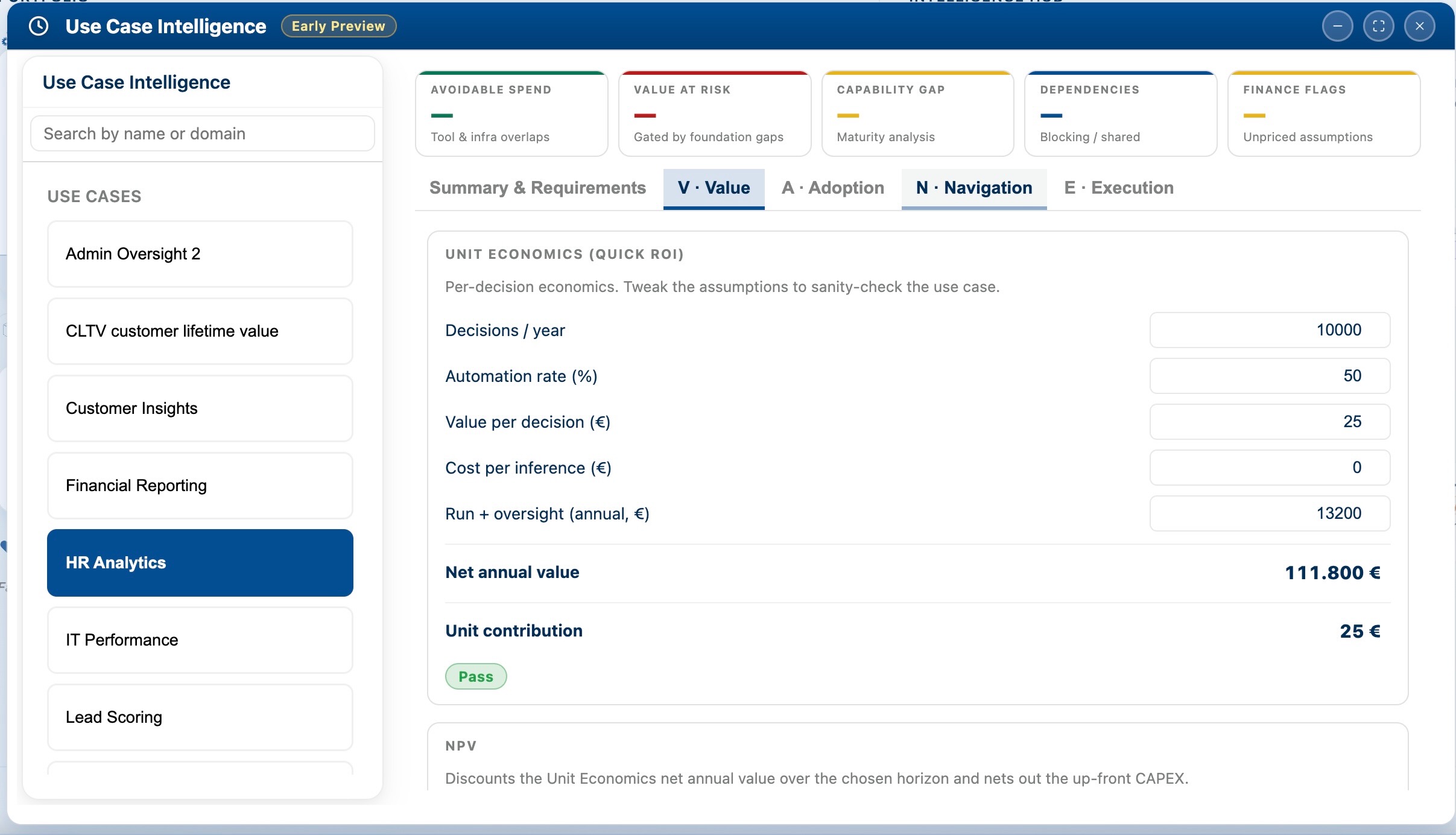
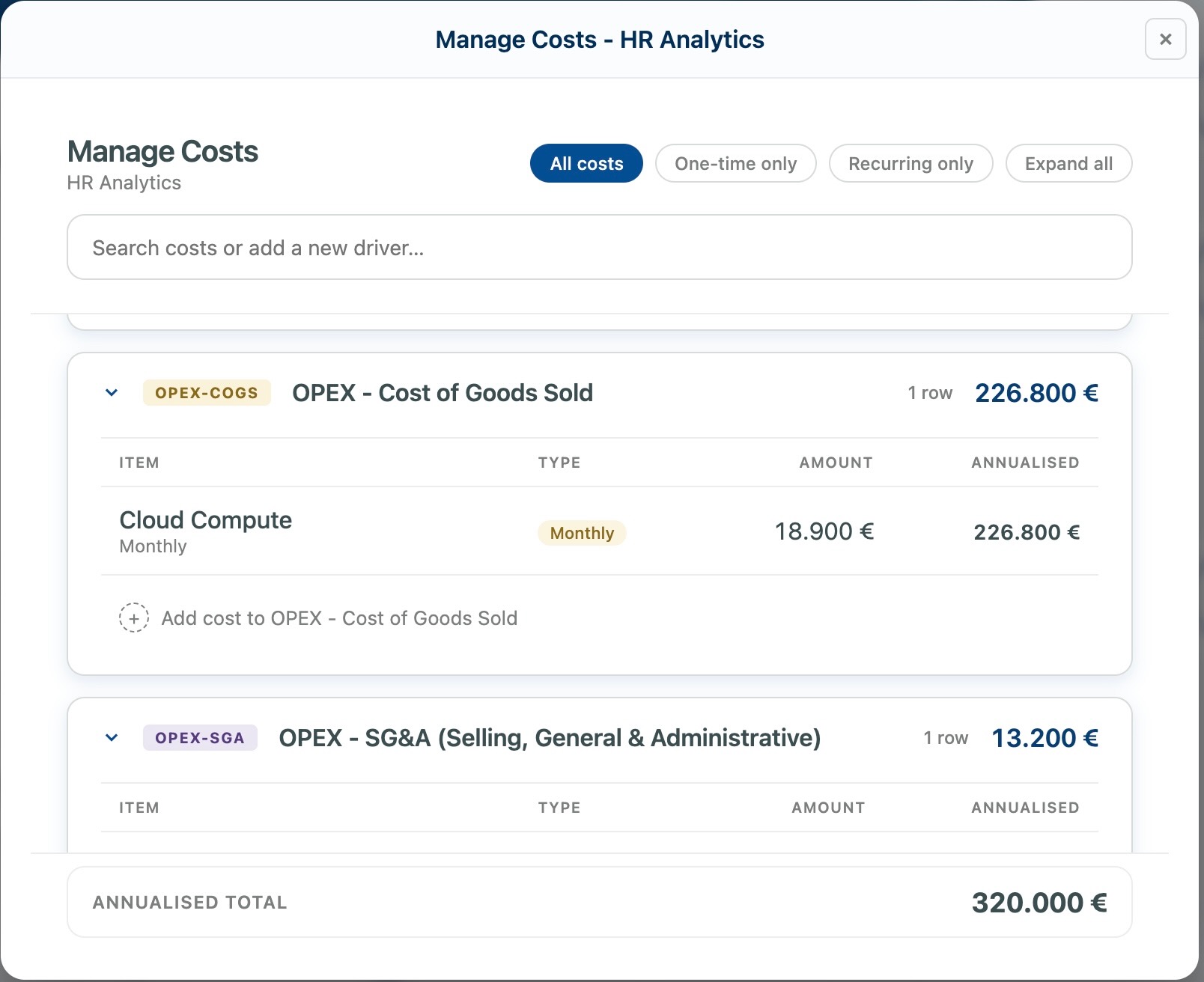
A finance-grade P&L, with the FTE and run cost included
Value mapping here is not a 1–10 score but real unit economics and a full P&L. The run-and-oversight line carries the people cost that business cases so often leave out, which is what turns an optimistic claim into a verdict a CFO can actually audit.
You can tune the assumptions — decisions per year, automation rate, value per decision, cost per inference — and watch the net annual value and unit contribution move with them. The numbers in the screenshots are one worked example, not a quoted result.
- Unit economics you can stress-test against your own assumptions
- CapEx, OpEx, COGS, and SG&A broken out and annualised
- FTE and run cost counted, not quietly assumed away
ALTITUDE 2 · STRATEGIC — THE GROUP PORTFOLIO
Now roll it up: where is the group duplicating effort, and what is being gated?
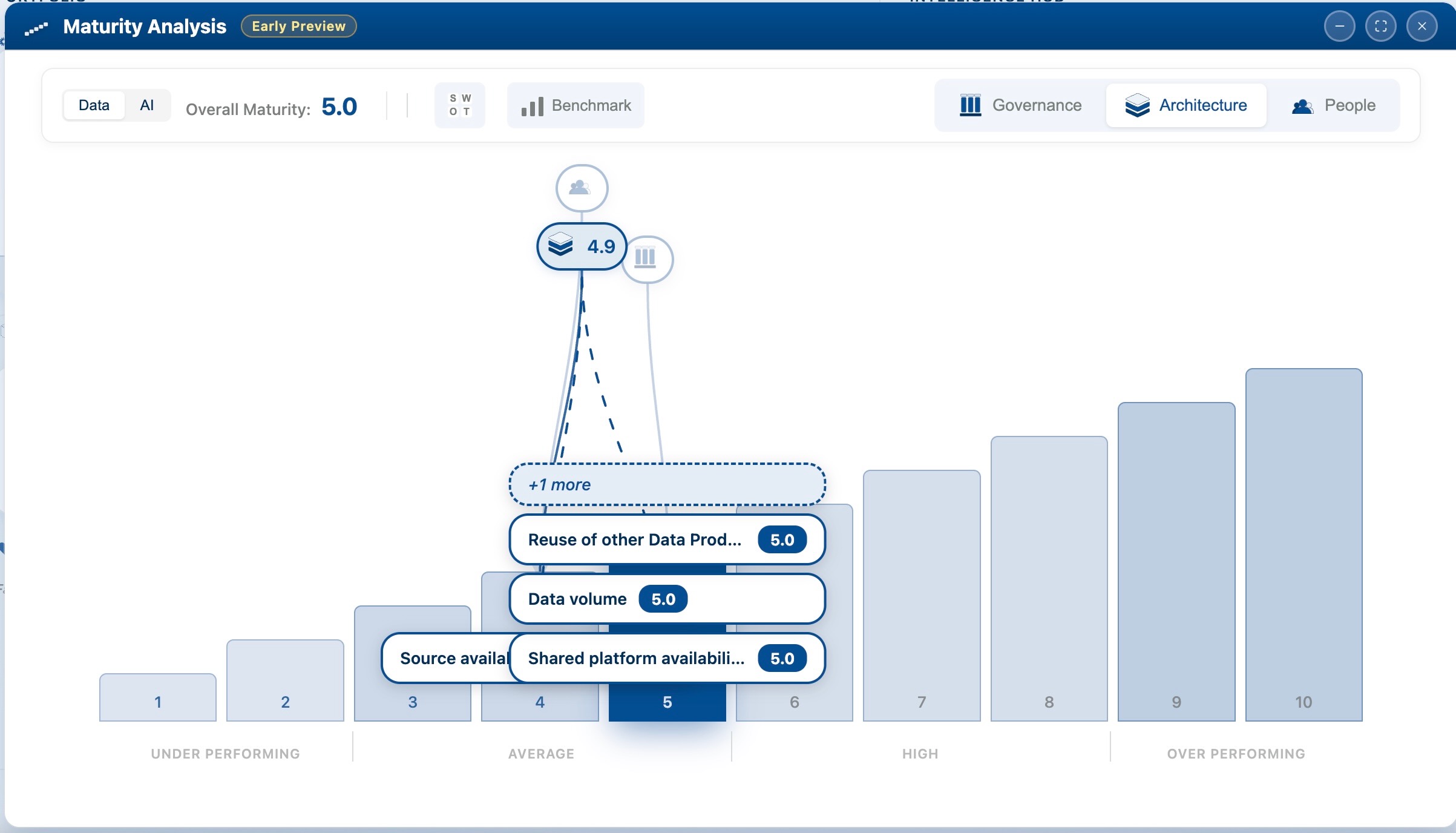
The same use case is one of many. At portfolio altitude, Vane Loop reads the whole estate at once, and the blind spots that no single team could see start to come into focus — overlapping platforms, a weak dimension dragging on everything downstream of it, and value that cannot land until a foundation gap is fixed.
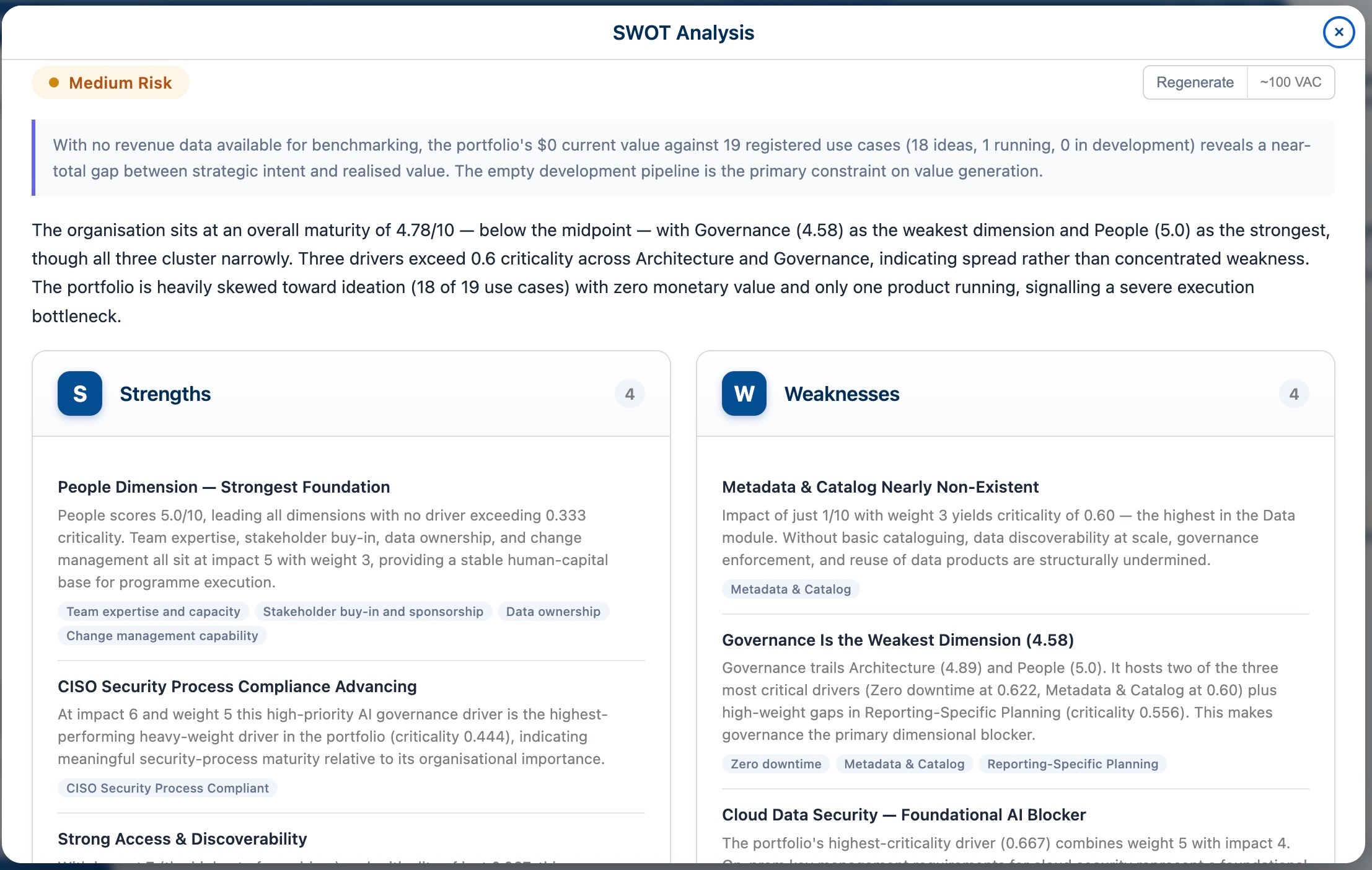
In an example like this one, the read-out tends to write itself: a portfolio skewed toward ideation with little realised value yet, governance as the weakest dimension, and a couple of foundation gaps blocking the use cases downstream of them. That becomes the brief for the forward-deployed team — fix the shared platform and the governance foundation first, and the gated use cases start to unlock behind them.
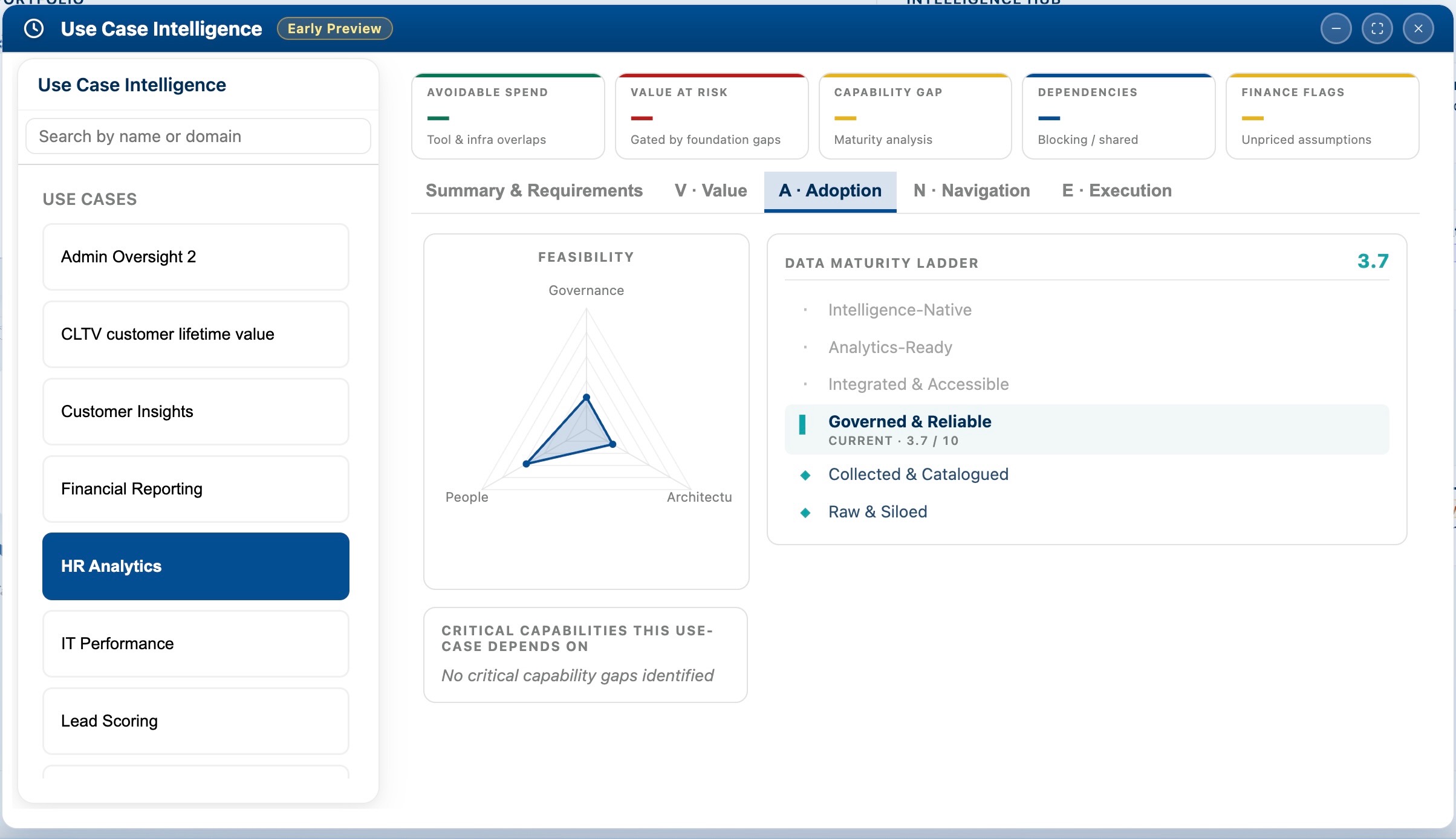
USE CASE INTELLIGENCE
Every initiative, read five ways at once.
Use Case Intelligence reads each use case against the entire memory of the company — every other use case, every maturity and feasibility score, and every individual answer — and surfaces the things that never show up one document at a time.
Tool and infra overlaps
Where two initiatives are quietly paying for the same capability twice.
Gated by foundation gaps
Return that cannot land until an upstream dependency is fixed.
Maturity analysis
The dimensions where the organisation is not yet ready to deliver.
Blocking and shared
What one use case needs from another before it can ship.
Unpriced assumptions
Business-case claims with hidden cost the P&L has not yet captured.
It highlights duplicate effort and architecture downsides, with the FTE cost attached.
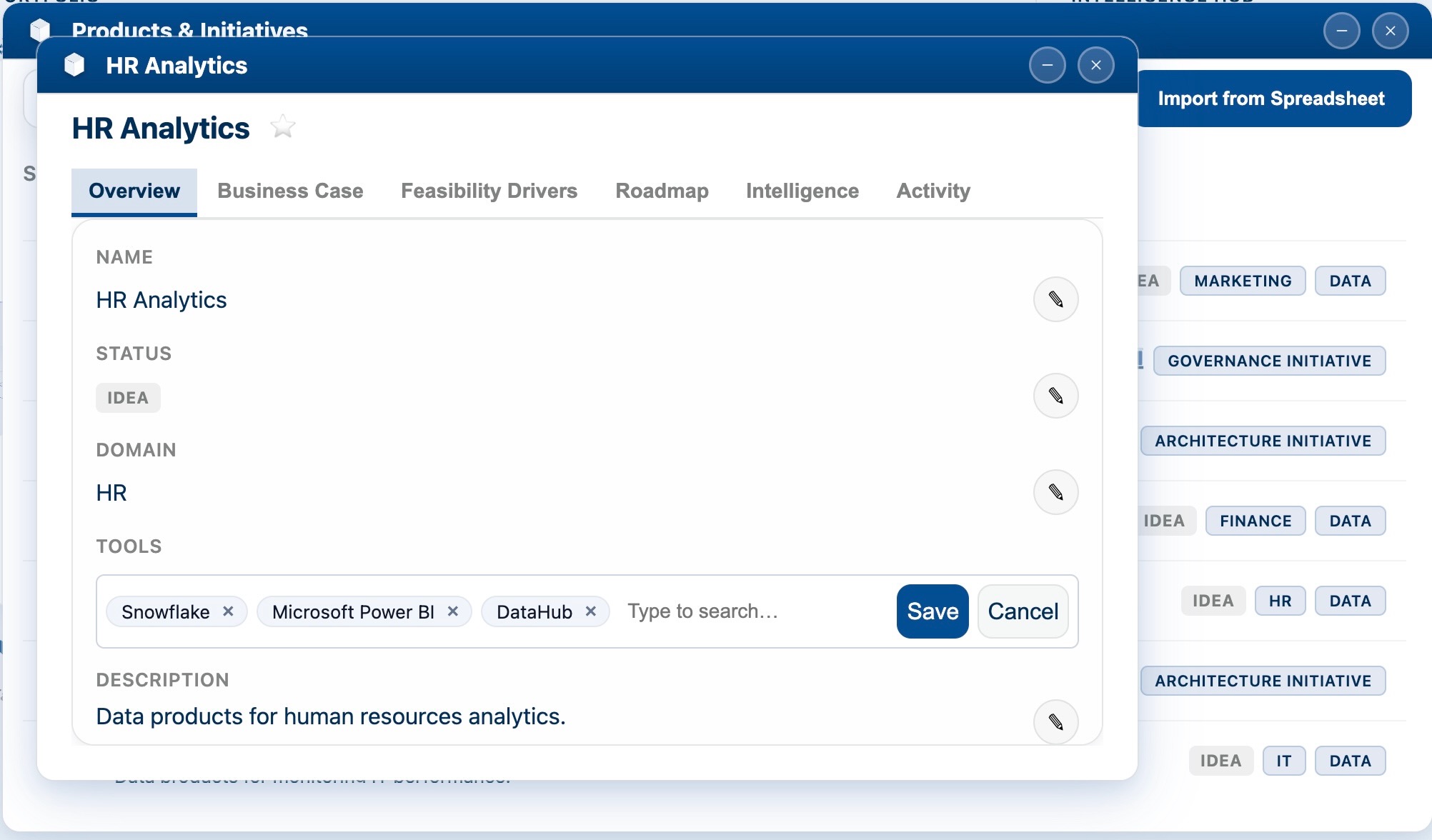
A use case can be captured from a document, a meeting, or by hand, and then tagged with its domain, status, and tools. From there the platform does the cross-portfolio reading: where efforts duplicate, where the architecture works against you, and what it all costs once people and run time are counted in.
- AI-generated insights grounded in the whole portfolio, not one use case in isolation
- Duplicate efforts and architecture downsides flagged automatically
- A full cost picture with FTE included, not just the cloud bill
TECHNOLOGY LANDSCAPE
See where data and AI technology overlaps, and what it costs.
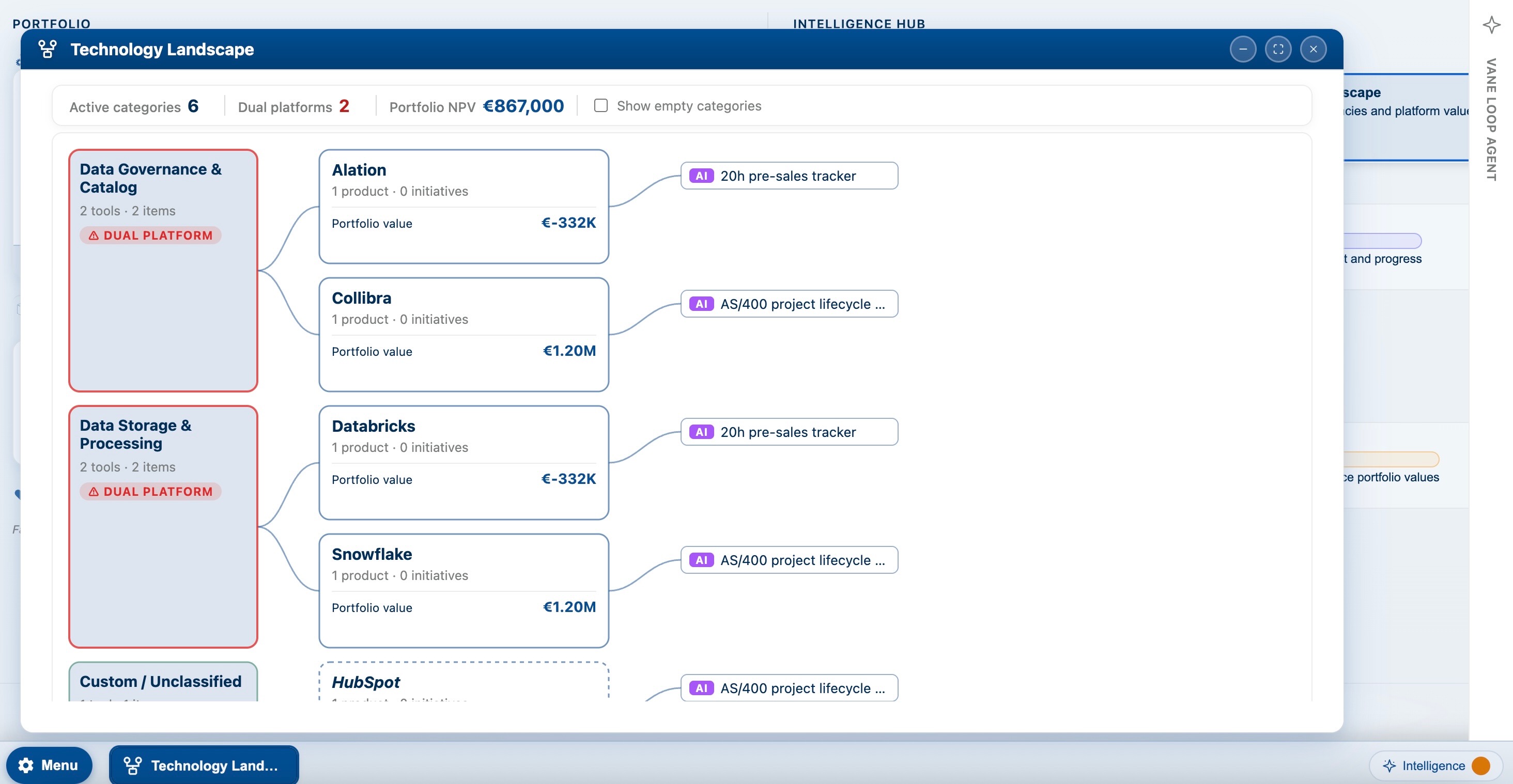
The technology landscape maps every data and AI tool in the estate by category, and flags where two platforms are doing the same job.
Those overlaps are the avoidable spend a forward-deployed team should retire before adding anything new, and because each tool carries its portfolio value, the conversation can stay about money and risk rather than logos.
- Tools grouped by capability, from governance and catalog to storage and processing
- Overlapping platforms flagged, with the duplicated spend brought into view
- Portfolio value and the linked use cases attached to each platform
THE VANE LOOP AGENT
More than a chatbot: it suggests the next question.
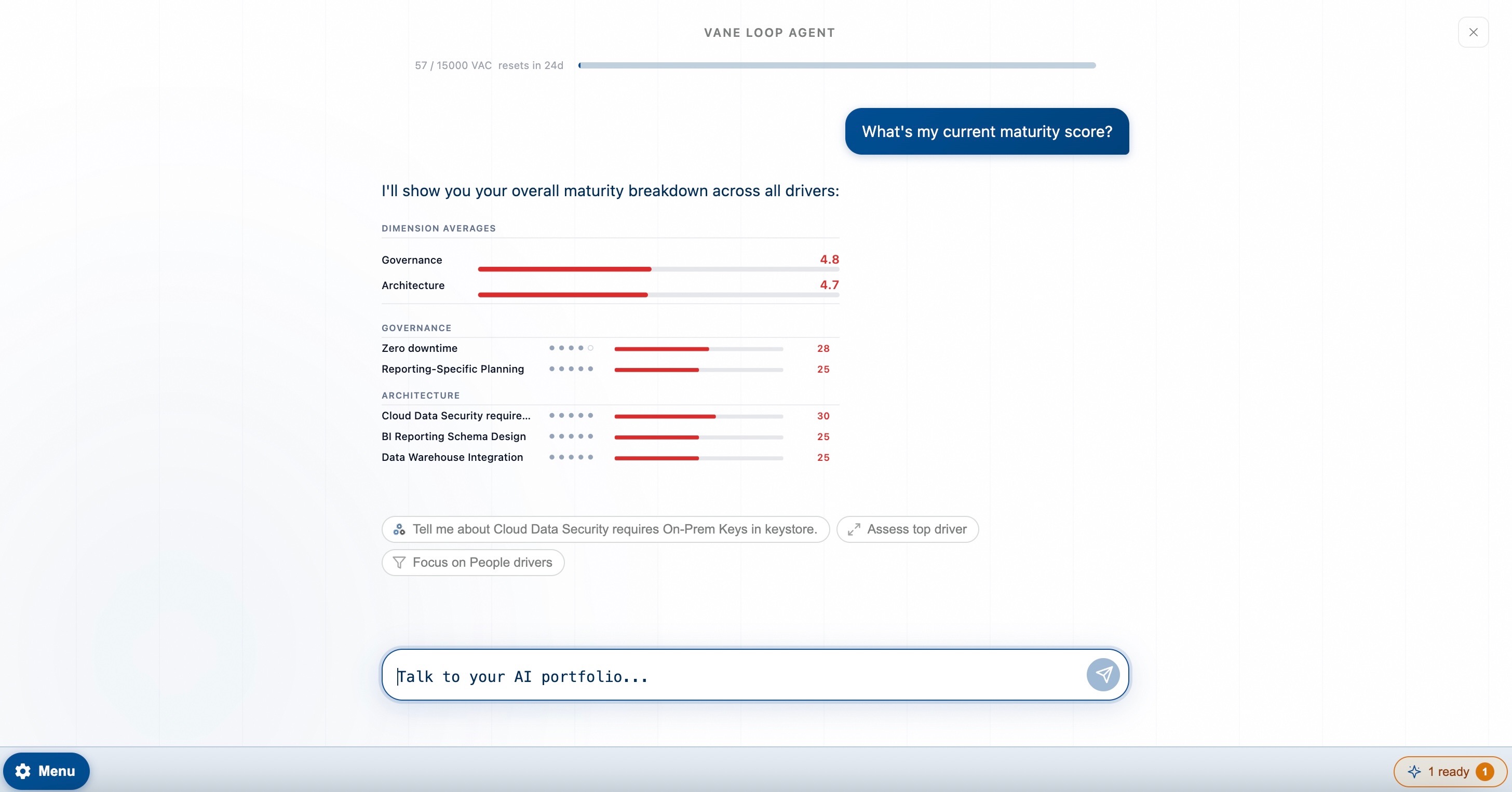
Ask it for your maturity score and it does not just answer — it breaks the score down by dimension and driver, and then proposes where to look next.
The agent works the whole constellation of issues at once. It resolves data and AI blind spots, connects a weak driver to the use cases it is blocking, and suggests improvements at both the strategic and the tactical level, so the next move is always already on the table.
- Suggests the next question instead of waiting to be asked
- Surfaces constellations of related issues, rather than one answer at a time
- Moves between portfolio strategy and use-case tactics in a single thread
STRATEGIC AND TACTICAL
One system, spanning individual use cases and group-wide portfolios.
The same evidence base answers the board and directs the build, which is what lets a forward-deployed engagement move between altitudes without rebuilding the story each time.
A single use case
For the engineer who is about to build it.
- Feasibility drivers, fixed and variable, scored down to the binding constraint
- Unit economics and a finance-grade P&L, with FTE and run cost included
- The next question, suggested — what to assess or fix before you commit
The group-wide portfolio
For the board and the relationship owner.
- Portfolio value, maturity by dimension, and an AI-generated SWOT
- Duplicate platforms and avoidable spend across the whole estate
- Value at risk, gated by the foundation gaps blocking it downstream
THE ASSESSMENT ENGINE
Backed by a 392-question maturity and feasibility model.
Every score on this page traces back to a structured questionnaire, so the assessment stays consistent across engagements rather than being reinvented for each client.
AIM THE ENGAGEMENT
Point your forward-deployed engagements at the value.
Run the maturity, feasibility, and value-mapping step first, and commit the team against evidence — the feasible separated from the aspirational, and every initiative mapped to effort, P&L, and return.
Related: Forward-Deployed Advisory · The VANE Loop Framework
All product names, logos, brands, and trademarks are the property of their respective owners and are used here for identification and illustrative purposes only; their use does not imply any affiliation with or endorsement by them. Product screenshots, and any figures shown within them, are illustrative examples of the platform's output and do not represent a specific client engagement or a guaranteed result. Third-party research is summarised in general terms; see the sources below for the underlying material.
Selected sources & further reading BCG — Artificial Intelligence at scale· MIT Sloan Management Review· OpenAI — News & announcements· Anthropic — News· Google Careers — engineering roles